The Vigiles Amicae is a roleplaying guild in Everquest 2, on the Freeport and Antonia Bayle Servers.

Saturday, May 10, 2014

Report: Taitos Erikson

Incident Report:
8 Blossoming, Fenin Ro, Veeshan
Attn:
Council, Senators, Tribunes
*
Location:
Jasmine Blossom Tea House, Mara
Regarding:
Follow-up on request for audience, Taitos Erikson
*
From:
Equites Amrunrosse 
*
Attachments:
initiation request form


I was recently contacted by the aforementioned male human in regards to the Declaration. This is the same that sent out informants attempting to get my attention recently from Halas.

I set a meeting in Mara, with Vigiles Karrha and Foederatti Kerrath assigned as guards.

Taitos sought the veracity of my claims, and seems filled with fury that such a being as Marconis can exist.

His primary motivation seems to be justice. 

I offered to welcome among the ranks, and he first reacted like he hadn't even considered allies. He accepted quite gladly. He has no oaths as yet to the Amicae.

I used my scape stone to pull us both to the hall and see to his room, as he had just gotten off the ship and went straight to waiting for me. 

He has not yet asked about his friend in Maj'Dul.

Friday, May 9, 2014

Survey of Norrathian History: The Age of Refuge

(( Technically, a portrait of Rokovon:
but seems like it might make a good frontispiece. ))

Survey of Norrathian History
A Neutral Account, Written for the Beginning Student 

by

Archivist Threadcutter

*

The Age of Refuge: The First of Our Own Ages

*

In the early days of the Age of the Shattering, the seas were riotous with tempest and thick with hungry drakes. No ship dared go more than half a day from the shore, and in those shallows lay the wreckage of the rent lands. As many fishing boats snarled on the ruins of lost towers as they did on reefs and rocks.

What survived of Qeynos was besieged by gnolls, and rabid, starving wildlings, and their own unquiet dead. The lawless and unlettered moved among them, smuggling contraband into the city, and stealing goods and people from it. Trade was chancy at best: every merchant that would make the attempt overland hired mercenary guards to defend them, for the Queen's armies were stretched thin already holding the city alone.

Freeport fared little better: the city's farms became a desert, and the orcs lay siege to the walls. They toppled the outer walls, and the city struggled to feed itself, caught between the unceasing waves of the orcs, the predations of unwashed bandits, and the ravenous unbound dead. The Overlord opened Citizenship to any soul who would swear to the city's defense, and created a new class of Overseers to rebuild the armies.

Between the riven contents of Karan and D'Lere, lies the Sea of Refuge. Though in the early days after the shattering it was fraught with tempests, they were shorter and less fierce than in the other seas. The sea claimed no few ships, but some of the souls, the sea gave back. Thousands washed ashore the islands and the mainlands, bereft of home and memory.

It was in these days that the Far Seas Trading Company was established. Initially the Far Seas was beholden to and permitted within neither remaining city, but had permissions to land at the colonies of both. They built an empire on ferrying supplies to ill-provisioned colonial outposts, and selling refugees to the commanders of the same.

Representatives of the Company were posted in two places along the Coldwind coastline: by the Antonican lighthouse and the Thundering Steppes docks. Along the Tempest coast of D'Lere, the Company was in tight competition with the Blackshield for the use of the outlying harbors, and relied instead on overland caravans from the Crossroads trade outpost to the treacherous pirate port at the Naythex beachhead. The Company maintains liaisons in these places even today, though the areas are pacified - almost civilized, compared to the days of Refuge.

Even in the chaos of the time, there remained some small settlements outside the great cities, and many of the martial, arcane, or mystical orders which had an establishment in relative seclusion chose to remain there despite the danger. Many of these, of course, fell to the ongoing tremors, the depredations of wild beasts, savage races, or the unquiet dead. Those who remained often signed treaties of fealty to the nearest City, and received a detachment of the regular army to protect them. Others relied on their ability to hire passing sell-swords and explorers to defend them or fetch supply.

It is difficult to convey to the modern reader how incredibly perilous the world was in this Age. The relative peace which is now enjoyed the world over was bought at great cost by generations of blood, and legions of elite heroes. The Reader who now shelters behind the great force-shields against the attack of the Awakened may well scoff at the idea that they live in an age of peace, but the heroes of the Age of Refuge would likewise be amazed to see drakes only in small pockets of the world, and it is unlikely that even a sight of any one of today's bustling harbors would convince them that the sea-lanes are well and truly open.

In this time, the Ulteran spire network was entirely shattered, and what powers it had once drawn upon were in such flux that even had the arcanists of the day recovered some fragment of how to work upon them, they would have been unlikely to survive any attempt to touch them. It is generally agreed by historians that the nexus storms were in many cases catalysts for the storms and tremors that manifested in the physical world, and may have lent a mad sort of strength to the savage races of the day, at the cost of course, of whatever sanity they might have once possessed.

It has been theorized that the savages have since been irreparably damaged in their blood by the chaos of that age, and their strength further diluted by excessive inbreeding. Various tribes were as isolated from one another as the outlying civilized settlements, with none of the natural advantages which our own peoples posses.

Likewise, the mystical circle-roads were impassable in this time. Some ruins of the original Gates remained, but though contemporary memoirs suggest they retained some resonance of their former glory, they were no more than nostalgic landmarkers during the Age of Refuge. Nor were all of them even discovered: like the ruins of the old spires, there were fragments scattered across the known world, and other pieces which were not discovered for generations after.

What little translocation and stasis magic did function in this era was exceptionally limited. Living creatures could only be moved a few leagues, and at great personal cost to the caster. Contemporary accounts indicate this cost was so great that it was indeed preferable to maintain a riding beast and remount string rather than rely on the mere possibility that such a limited Gate would function at need. The most common use of these limited magics at the time was by the various courier companies which together composed the world-spanning Post. Nothing larger than a single cubit could be sent by post at all, and the magical cost of maintaining the letters and parcels in such stasis was significant at the time. In many cases, it was cheaper to hire a physical courier for such work, and there is strong evidence that such work comprised at least a quarter of the work done by free-lance bonded mercenaries.

The chaos of the outlands was so extreme during this age, in fact, that securing food for the cities was a significant logistical problem. The fertile land in Karan yielded more, of course, but the variety was severely curtailed by what could be grown quickly in that climate, and brought to the city for preservation. Exorbitant tariffs and trade restrictions were put in place by the Queen and the ruling council against all foreign food and drink: the proceeds were funneled directly to that portion of the Army which oversaw the planting and harvest in Antonica itself.

D'Lere, of course, has always been a harsher sort of country, especially after the irrigation system in the commons was destroyed by the catastrophic events following the Shattering. Early attempts to militarize planting and harvest proved disastrous, and led to the loss of three outlying districts of the City itself to the invading orc tribes. Shortly after that, the Overlord began issuing letters of marque to ships as well as land companies, and these were written in such broad strokes as to legalize the seizure of ships, wagons, artifacts, and provisions from any "Enemy of the State" for any cause whatsoever. Enemies of the State remain loosely defined to this day as any citizen of a foreign power not currently in formal alliance, or treasonous citizen of Freeport itself.

Mercenary companies who did well on these ongoing supply raids were the first to be tapped for more targeted work: rogue arcanists, revanent epidemics, drake nests, savage warleaders, lesser wyrms, and the reopening of trade routes. The Reader who is interested in the histories of individual companies will find few official histories from this period, but it was not uncommon for officers of these companies to keep personal memoirs.

Those who were lucky enough to live to something like a retirement age often published revised versions of these as entertainment: the taste of the time tended toward such things, and they were read in much the same spirit as the patently fictitious, sensational "confessions" and wonder-tales of the day. No formal exercise of history was practiced at that time, and there is little evidence that the reading public discerned, or even had concern for, the distinction between fact and fiction in the chronicles of their age.

It leaves us, therefore, with a curious but sensational muddle, to tease out the threads of truth and bombast from one another as we attempt to reconstruct the details of the age which had so much to do with how our own was formed.

Monday, May 5, 2014

Report: To the Council, Regarding potential ally of Marconis

Incident report 
5 Blossoming in the Year of Fenin Ro in the Age of Veeshan
At: 
Soulfire club
Regarding: 
new meeting, Veset, a potential ally of Marconis
From:
Equites Amrunrosse

I attended the Soulfire Club initially as an official Priestess of Bristlebane on the night listed. It seems to have recovered from what hold the Great Prankster had on it, save there was a sentient Billy that wanted a story.

It was after the doll was sent away that a young, rough, androgynous woman joined me, commenting on being called Professor by Euryale. She said the Boss never used that title for me before.

The woman refused to reveal who the Boss was, and I employed a staff member of the Soulfire to assist in this.

Needless to say, I have only suspicion.

However, I did see the woman leave with a fae, and after explaining to the staff why I wanted to know who the Boss was, after some confusion, I found the fae was sibling of a sort to Koural, who is daughter to Ginneve. Also in attendance was Amaury and Vezzexx, a monk and Necromancer in training.

I lead the trio to the clinic listed as Veset's and stayed out of sight. The fae was recovered, though Koural seems to have been bespelled and claimed weakness and exhaustion. I had us retreat, still not learning who the Boss is.

We went back to their stronghold, where I gave some instruction to Vezzexx to attempt to heal Koural. I left before I could ensure she was fine, but the healing was going well.

Before leaving the Soulfire, I left word with Veset that I would await her Boss on Lucan's Mount. I am observing the area, and requesting back up in case it is as I fear.

Selections from: Notes on Diverse Magicka - Kenetica

Notes on Diverse Magicka

by

Legatus Pax Sytan Fiac


Author's note:

This is a series dedicated to informing those with limited or non-extant abilities in arcana on the various forms of magic and their uses. This is not intended as an in depth study, nor does it go into all details. For many, the usage of leylines or nodes will never manifest, nor will the finesse to guide the blood magicka explicitly.

This discourse will cover the concepts of similarities and differences among the branches, and peel back some of the mysteries.

The first section will cover my specialties of hematurgy and necromancy.
The second will cover natural magicka.
The third will touch on the psionic talents.
The fourth will delve into the divine controversy.
The fifth will touch upon the delicate and complex question of void.

It is to be hoped that the interested student will find the more technical treatises on the above topics more readily accessible for this humble offering. Any errors or elisions in this work must be attributed to the difficulty of enumerating in plain language what becomes a nearly reflexive, intuitive impulse for the grand adept.


Natural magicka can be broken down into the two base components that are very much related to blood magicka. In the previous section we gave our attention to the so-called pure Elementalist, and in this we shall discuss the most common expression of the kenetic type: conjuration.

Conjuration is, as previously stated and all other writings on the subject indicate, related to necromancy most closely. It relies on ritual and animation to direct and guide an action.

However, conjuration itself is a misnomer for most. It captures everything from making giant golems to the journeyman kineticist working the shuttles on industrial looms. All conjurors gain the skill necessary to do the smallest of the works - simple animation, and only those, again, who can work the leylines and nodes can accomplish the larger scale works.

It is worth noting: where the elementalist by definition must be able to See and Feel the magic they work with (although they may not be interested or capable of putting that experience to formal analysis) the keneticist has no such limitation and in fact, they are unlikely to miss the ability at all. They work directly upon existing manifestations of both pure and mixed elements, and with similarly physical creatures thereof.

These two extremes show how differently the paths branch - one is most significantly military, and the other most significantly civil. No matter the background or civilisation lived in, there will always be pressure to find what is the most that can be done in the full exploitation of any skill. The kenetic collegia have often been referred to as the Wellspring of Industry, and that designation is as pragmatic as it is poetic.

This does lead to some error in understanding the skill base, as a conjuror that can make a golem could run more than half of a city’s industrial equipment alone, and unaided. Similarly, the current industrial kineticist could be utilized for launching small, numerous, destructive projectiles with a corps or archers. The fact that Industry and the various militaries do not organize in that manner is as much a factor of custom as of suspicion and greed.

Those conjuror-kenetics who can subjugate a Greater magical creature - or animate a vast mass with artificial sentience under the direction of the caster's will - rightly terrify both the lords and dependants of Industry. Accordingly, the various collegia are united in ensuring that those with such potential are herded to the battlefields along with the Master and Adept class elementalists.

It is more comfortable for the untrained masses to honor their fallen Arcanists as Great Heros, than to learn to school their fear of such power moving too closely among them. What mundane mortal could gainsay the demands of such a person, should it occur to them that they are, in fact, in a position to make those demands? No reader of this work can be unaware of the tyranny that may arise among the mundane, and it may perhaps too easily be imagined what terrors might manifest under a mageborn regime.

I digress.

Because of the difference in power and the personal energies being so varied, it is not feasible for even a large group of kineticists to summon a golem for longer than a few minutes. As soon as one is out of their personal reserve, the bit under their control would fail. Accordingly, the kenetica rarely work cooperatively, or upon any of the permanent magics.

The rare exception is the Grand Adept of the Kinetic Arts, who through intuitive or ritual harnessing of node-bound mana is capable of crafting immensely ingenious automata - many of which may continue to function long after the death of the caster. Properly tuned and maintained, these Permanent Kinetic Magics can be tended by a specially trained cadre of lesser kinetics even though they could never recreate them once destroyed.

There is not as much competition among conjurors as there is among necromancers, but among the Masters and Adepts there still tend to be intrigues. These skew towards matters of military, rather than magical interest, and therefore is of little relevance for the casual student.

There is not as much to say about the functional details of this line that has not been discussed and compared in other works. The only remaining crucial point is this: where a kineticist is unlikely to be capable of manipulating greater magical forces by Sight and Feel, the usual course of extensive memorization and precise ritual may be entirely circumvented if they have the luck, talent, or ruthlessness to acquire a True Familiar.

Not all magical, elemental-bound creatures have the capacity to serve as a True Familiar, though they may aid a mage's work by increasing their base affinity with that element merely through proximity. Those that do have the potential to become True Familiars, could well be classed as mages themselves. Through their alliance with - or control over - those creatures, a Kinetic may well amass and deploy such immense power that they can - and do - challenge the greatest of Grand Adepts.

The reader by now must be well able to imagine what consequence such association or exploitation this practice may have on the sanity and ethical capacities of both Mage and Familiar, and no doubt is aware that many of the great mage-battles of the past have involved at least one such pairing on any given side.

Therefore, we close this lecture early, and move to the next general concern, which has personal significance for even the most unMagickal of persons.

Saturday, April 5, 2014

Selections from: Notes on Diverse Magicka - Elemental Arcana

Notes on Diverse Magicka

by

Legatus Pax Sytan Fiac


Author's note:

This is a series dedicated to informing those with limited or non-extant abilities in arcana on the various forms of magic and their uses. This is not intended as an in depth study, nor does it go into all details. For many, the usage of leylines or nodes will never manifest, nor will the finesse to guide the blood magicka explicitly.

This discourse will cover the concepts of similarities and differences among the branches, and peel back some of the mysteries.

The first section will cover my specialties of hematurgy and necromancy.
The second will cover natural magicka.
The third will touch on the psionic talents.
The fourth will delve into the divine controversy.
The fifth will touch upon the delicate and complex question of void.

It is to be hoped that the interested student will find the more technical treatises on the above topics more readily accessible for this humble offering. Any errors or elisions in this work must be attributed to the difficulty of enumerating in plain language what becomes a nearly reflexive, intuitive impulse for the grand adept.


Whatever the degree, a Mage has a personal well to draw from in some finite means. The inclination of each Mage will determine how it can be used. For example, some incline towards creating fire through the manipulation of thermal energies, and others to the formation and direction of ice through the same means. Others develop towards what may be broadly defined as kineticism, which mechanisms have been of vital importance to the stability of Industry and numerous mechamagical developments.

Elemental magicka can be broken down into the two base components that are very much related to blood magicka. The first we shall discuss is considered by most academia to be “pure elementalism”, or working only the elements and not adding a layer of compulsion or animation.

As such, elemental mages tend to work like a hematurge, casting by intuition and intent rather than full ritual as they advance and age. Many of the same principles apply, especially the possibility for an elementalist to work some magics generally considered beyond their reach through cooperative or ritualistic forms. The biggest main difference, however, is incredibly stark: there are no Grand Adepts among Hematurges, howsoever much blood may be spilled for their art.

An elemental mage may not necessarily became as powerful in their art. Some are born with the predisposition towards working with leylines and nodes, as in the case of the previously discussed Master and Adept rank mages, and some are not. The issue cannot be forced without serious and usually deadly consequences: cooperative Workings which would touch one of the Greater Nodes must place one arcanist of Grand Adept potential - even if they are untrained - in the central working position, or the Node will consume the entirety of the circle that dared to attempt the harnessing. Similarly, a ritualized Working meant to mimic the praxis of a higher-level magus has an exponentially increasing chance to consume the working Mage as part of its power source as the demands of the Work also increase.

The so-called “weaker” elementalists tend to be called hedge wizards, though it would be folly to assume that someone working the lines and nodes would always represent a more formidable power, whatever the formal designation for them.

This main division causes interesting effects, as a hedge wizard is able to refine their arts gain a vast understanding of what they can and cannot do. Masters and adepts, for all they handle more power, tend more towards be a channeler of energies and act as a funnel. They tend to miss many of the finer details of spellcraft as so much is transpiring during a casting, and to direct such vast power toward anything requiring finesse invites disaster. It would be as well to chain a greater fire-drake to light a single candle. Additionally, there tends to be a higher cost to the castings they make and are too exhausted to immediately set themselves to examining how their spell worked and “felt”.

These classifications are vital to understand as the training either branch will get is vastly different from the other, and again vastly different within their division to further narrow a particular specialty.
Not all people can do all things, and not all mages can cast all spells or work with all elements.

Regardless of form, elementalism can be broken down into intention and connection, and kineticism can be broken down into subjugation and animation. The first style tends to be elemental in nature, such as calling forth Fire or Water, or manipulating the properties of Wind, Wood, or Stone. That is not to say a personal affinity or talent for any one element precludes a kenetic's working upon them: it is more a question of whether the mage works with potential or actual manifestations of their chosen element.

The pure elementalist may seem to create physical manifestations of their magic from nothingness, but in practice they are manipulating the latent potential in a given medium, supplemented by what proverbially "raw" mana is available to them.

The kineticist frequently seems to work in a more accessible fashion, for example, by directing where existing mundane water should go to, and in what form. The reader may rest assured the matter is more complex and wonderful than it may first appear, and do well to remember that nothing whatever prevents the emergence of a Grand Adept among the kinetica.

Intention gives shape to the elemental spell. From a simple fireball to a complex ice wall, the elementalist guides the form of the casting, and again it can be done almost intuitively. Most mages undergo extensive training in the focus and refinement of their will, for a vague intention predictably creates a vague result, but it is entirely common - especially among the shorter-lived races - to encounter a particular innate talent for such focus which requires very little help to manifest exactly what the mage desires.

The major difference comes in connection. Rather than a sympathetic connection to a target, an elementalist relies on an innate understanding and connection with the element of the spell. This, of course, is the reason why pure elementalists are often surrounded by - and work with - creatures of elemental magical nature, even though the nature of their talents frequently preclude any possibility of actually ordering them to assist or carry a Working. The greater the connection, the more strongly the mage may channel, manifest, and manipulate that element.

From that point, the target will find harmony with the spell, or it will not. Elementalist training frequently focuses on internalizing the properties of every possible material relative to the element or elements which the student has the strongest talent for. For example: a fire spell used on water will find harmony if it is shaped to manifest in diverse mage-fed particles throughout the water, exciting and infusing the water with immense heat for an explosive result, even at a great distance from the fuel source. A fire spell which asks the water itself to burn, however, will pull immense power only to fizzle in disharmony as the spell seeks and fails to find sufficient potential Fire in the water itself.

Wednesday, April 2, 2014

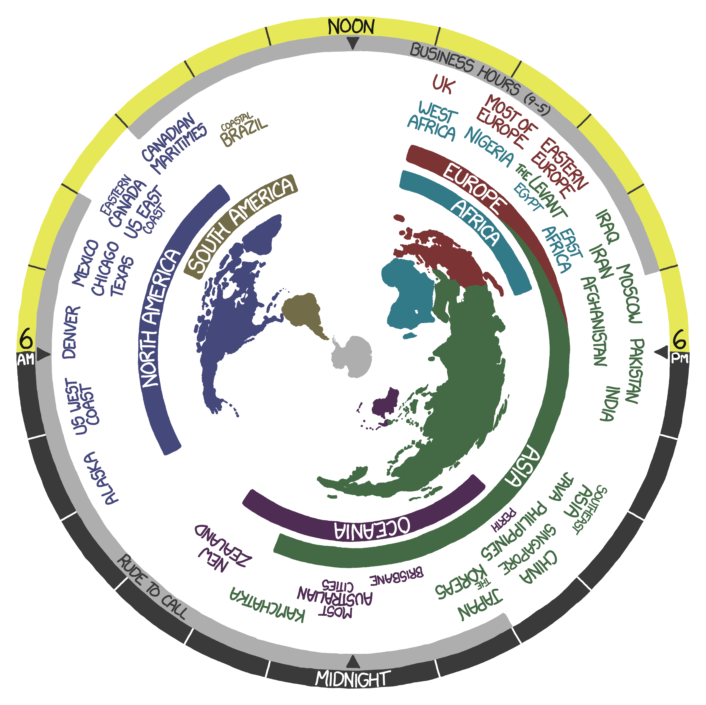
What time is it?

A handy visual map of world time,
drawn by the awesome Randall Munroe at xkcd.com .
If it's rude to call their area at a given time,
it's also unlikely you'll see those people at an online event.
Keep this in mind when scheduling RP or hunting!

Nearly Midnight News, March 28th

*crawls up to a pile of ashes*

“Oh gods, oh gods... get me drunk and then mess with my place in time..."

*looks at the pile*

“Someone burned my desk… I mean - seriously... Make me crawl from bar to bar..."

Kyrafym tells RPLFG, "well... thats an awkward realization... "

"And then my - oh. right. desk was defiled… Need to remember to post that around. Bloody Erollisian priest..."

*slowly stands, wobbling*

"Welcome to the Nearly Midnight News, Vithing Erollisian edition.... Or was it Bloody Chronomancers edition… Perhaps Turn Off The Light I Have A Hangover Edition… ... Or the Why Does This Bovid Have Wings Edition."

"Anyways! News! With hangovers! Hurrah.”

*not amused*

"In tonight's news, we go to The Past (TM) and find out.... just what the hell."

"In Antonica, a rare sighting of Fippy Of Yesteryear allowed us to get a brief interview. We asked him why he tries so hard to break the wall."

"His response: "Not break! Climb! Those dumb Qeynos people just ruin my exercise! So I hit them!" Truely an endeavoring spirit, he has tried for years just to do a pole vault and wall climb. And those darn humans..."

Kyrafym tells RPLFG, "the irony is ... i could see fippy doing that -.-"

"There is no irony here. Only news. Pure facts. Can't make up facts."

"In other news, my Holy Of Holy - er - Fizzlethorpe's Holy Days are upon us! Many are celebrating in the time honored tradition of killing other people in creative and sadistic ways! Less noted are those who are putting poo in a bag and lighting it on fire on Old Dave's doorstep."

Kyrafym tells RPLFG, "-shocked and terrified face- "

"Flaming bags of poo are just so naive and juvenile compared to death. Other festivities include buckets of water over doorways, and transporting someone into a full replica of their home, minus all the people there. And one spirit known only as the Prankageddon has sold the Qeynos Claymore to at least three different scrap companies."

Kyrafym tells RPLFG, "BUNNEH!"

"And we must never forget the easiest of pranks - setting a cup of water on someone's bedside and easing their hand into it. This can be done by nearly anyone. And just goes to show, if you set your sights low enough, you can do anything."

"A new strain of degenerative cubism has been released in Odus. It seems to affect something like 47% of all Erudin."

"So far, it has remained isolated in Paineel, though if it were ever to become airborne, the general block-shaped head you see today would spread, and incubation would likely affect the entire body after a critical mass. Experts agree - Erudites would be one block representing the forehead, an egg that might be the body core, and three sticks, possibly representing a cry for help, or a new spell."

"Work is underway to reverse it, and this so called Realism vaccine has had interesting effects. Sadly, one of them is a slight chance of surrealism, making the affected erudin become an angry badger, a book, and a loose pile of string being chased by a cat."

"Paineel has never been more awesome. And that is a professional opinion as Grand Poobah of Fizzlethorpe."

"Elsewhere in Norrath, and less awesome by leaps and bounds, we find our next story in New Halas where Fae unions have been authorized."

"The measure was passed despite worries of regions developing condensed sugar and unmitigated energy. Most experts suspect that it was this phenomena that took down the spire network so long ago."

"Dissenters hold that the Fae can unionize just like any other race, and that there are no side effects to this. Except for the dissenters of dissenters - Nerians hold that Fae unions would not only have side effects, but they would be almost pointless, and therefore able to be ignored."

"A side effect of this measure causes discussions of the hitherto illicit Fae days to resume. New Halas has become a hotbed of Fae activity, and all other sentient races are smart enough not to touch that with a ten-point-two foot pole. Which is a little obsessive, rally, as most Fae are only 3 to 8 inches."

"The NMN would like to point out that pigs were proven not to fly last month, and Bovids are just as unlikely this month."

"However, we seek grant monies to do a thorough and expensive investigation. For those who wish to waste - er - participate in this, please send all inquiries to NMN staffers directly. This is totally Tax Deductible. Meaning that yes, taxes will still be deducted. It will just be harder to calculate."

"In sports this week, we were going to go live to a new team in Enchanted Lands, but when we got there, we only found a huddle of goblins."

"They were calling themselves The Profits, and wanted to play against the halflings. When pressed, the leaders could not say what they wanted to play, or how to play it. Only that they were the True Profits."

"Goblins. Need I go on?"

"Odd weather today - Half of antonica experienced a snowstorm, and the other half experienced the worst case of 72 card pick up in recorded Bristlebane history."

"Residents of Windstalker were torn, sometimes literally from papercuts, in how to respond to this. Some opted on snow forts, and others on houses of cards."

"Rivervale had three inches of spaghetti at about noon, and it was all cleared up by weevils by 4."

"Thurgadin didn't have snow, causing mass panic."

"There was a small bit of continental drift when D'Lere wanted to demand it's land back from Karan, but after a brief talking-to by the Feerrott, went back home. This happened at about 7 pm, and was saved from becoming an Incident by sheer force of smell by the Feerrott."

"I am your anchorette, Folodu Amrunrosse, which I did not say earlier I don't think, and This Is Sparta!"

"Er… Nearly Midnight News. Good night and good luck."


editor's note: 
Maiden’s Fancy's and Vanesh's multiple advertisements during the broadcast have been excluded. The NMN staff does not look kindly upon opportunistic spamvertisements.