The Vigiles Amicae is a roleplaying guild in Everquest 2, on the Freeport and Antonia Bayle Servers.
Showing posts with label resource. Show all posts

Tuesday, May 27, 2014

Reflections on the Writ: Respect

The rules at the heart of who we are, that make us Vigiles, are of prime importance to every one of us. It is the concern of every Vigiles to see they are upheld, and the special duty of the officers and Council to ensure that this is so.

The official summary of the OOC rules is posted here, and was drafted to be as concise, readable, and clear as I could make it. It was also drafted to fit neatly inside a player-written book in game, so that it could be posted publicly in our guild spaces, and shared with our members easily.

The entirety of the ooc rules can be reduced down to our driving ethic: act with love and justice for your fellow players. 

Or, as Wil Wheaton so eloquently puts it, Don't be a Dick.

From time to time, it is well to expand on a matter in greater detail.
We are surrounded by a world that regularly fails to promote love or justice, and we carry with us all the many wounds from that. Within Vigiles, we strive to re-imagine the structure of our world, together. We do this through our collaborative creative fiction - our role-playing - and we also do it in the community that we have built among us, the humans behind the stories.

We are human - and we will have conflict, and we will all fail to embody the ideals we strive for.

It is not a matter of if, only "when" and "how".
Learning how to move through the tense and uncomfortable places to become better versions of ourselves is an essential, beautiful, difficult, and necessary work. It is of vital importance that we work together in this process, to check in with one another and remind each other of the ideals and friendship that bind us together.

Respect the players. 

That means you.

Every one of us, in joining the Vigiles, has sworn to uphold the Writ and Rules, without exception. You have the same right to a safe and healthy storytelling gamerspace as every other member.

Any insult or harm you suffer is our concern - and at the same time we, the officers, cannot act to resolve the situation if we do not know it exists. We are human, and Real Life comes first. Not every officer can be online and attentive to every channel at every moment, and it would be injustice to expect that from those who serve out of love.

We actively work to build a community that acknowledges the danger and injustice of structural violence. We refuse to allow anyone to seed such harm in our space.

Just as within the Amicae no character is permitted to attack another Amicae for their race/gender/religion/class, no such insults in real life will be permitted among guildmates. Swearing is permissible, but language which has its basis in denigration or oppression of any group will invoke discipline.
Likewise, no discrimination based on account level will be tolerated.

Oppressive language has some obvious examples: slurs and insults, gross generalizations and stereotypes, violence and threats.

These are the even-con, aggro monsters of our world, outlined in bright red and easily seen from a distance for what they are.

There are also subtle, insidious kinds of oppressive language, which cloak their oppression in the veneer of other things. Taken alone, one comment may seem trivial: as part of a pattern, it becomes malignant. Violence may masquerade as reason, or humor, or even concern.

It is important to remember that your inability to see or feel the harm does not erase its danger and hurt for another.

These are the quest npc's that become epic raid bosses, these are the invisible vampires that wait for you in dark corners.

We do not often see such things arise among us, and what does slip through quickly becomes an opportunity for growth. We all carry some level of privilege from our Real Life into the storytelling space, and it is our responsibility to endeavor always to check that privilege.

When we overlook some part of that, we are asking our Amicae to check it for us, so that we may grow. The officers of the Vigiles Amicae have sworn to this duty, to monitor what they hear, and to hold safe space for Amicae to bring their concerns. When that happens, an officer steps forward to remind us all about our rules, and we open a public discussion of what those rules mean in application.

We in the Vigiles believe that this public discussion is essential to the health of our community.

There is a time and place for public and private discourse: privately approaching an officer will of course remain a private discussion between you and the council. Generally, official complaints are made in private, even though frequently they concern public actions. Public reminders also frequently lead to private discussions in greater detail than is feasible in a public forum.

That manner of private discourse is good and healthy.

Reminders are delivered publicly, because we all need to know them. If even one person is unclear as to the application of the rules in practice, it is certainly true that more than one harbors similar confusion. Successful conflict resolution brings us closer together, and actively builds the world we seek.

We of the Vigiles strive to incorporate the practice of Nonviolent Communication, while at the same time working to identify and disarm any structural violence we carry with us from the outside world.

Responding to gentle reminders and critique as though it is a malicious personal attack is a terrible thing for everyone, and actively undermines the health of our community.

Lashing out with violent language at an officer - publicly or privately - for issuing a reminder is a serious transgression: it is disrespect for our rules, and our officers.

Likewise, arguing for exceptions to our rules for any reason whatsoever is an act of violence against the Vigiles, and will be handled as such.

Once, will earn a formal warning, and redirection to review our Writ and Rules for later discussion. Refusal to comply will be considered a second violation.

Twice, will earn a formal rebuke, assignment to review the Writ and Rules, and report to an officer for further discussion. Refusal to comply will be considered a third violation.

Three acts of violence against the Vigiles, IC or OOC*, will result in formal charges of treason, and may invoke a sentence of Exile.

There is a time, place, and manner in which to bring your concerns and questions to the council, and learn about our Writ and Rule. Take time to center yourself, and approach the issue with clear language, and without value judgments. We, the officers, have sworn to uphold the Writ and Rule, and also to educate the Amicae in it. Come to us with any questions or concerns you have.

Your feelings are yours, and you have the right to feel them.

Notice your fear, your anger, your sorrow: these arise within you to tell you valuable things about your experience. Respect yourself as a player, as an Amicae, and speak up. Trust that you will be heard. Your officers are there to help you process your feelings and experiences among us, and to take action in the community when necessary.

Not every character or player will feel comfortable in the space we have created. Our work is sometimes exactly that: work. We believe that even - perhaps especially - in the context of a game and storytelling space we all love, that this work is good, and right, and rewarding. We invite you to remain with us in this good work, but we accept that the difficult road is not one all souls may walk.

We, the officers, have sworn our time and our hearts to the work of holding the banner on that long and difficult road.

We welcome you among us:
stand with us, and our strength and wisdom together 
shall be greater than the sum of all we had alone.


* Yes, in-character treason and exile is a story you can write. Those plots are deeply complicated, and require excellent out of character communication to play out, while guarding the health of the players.

Monday, May 5, 2014

Selections from: Notes on Diverse Magicka - Kenetica

Notes on Diverse Magicka

by

Legatus Pax Sytan Fiac


Author's note:

This is a series dedicated to informing those with limited or non-extant abilities in arcana on the various forms of magic and their uses. This is not intended as an in depth study, nor does it go into all details. For many, the usage of leylines or nodes will never manifest, nor will the finesse to guide the blood magicka explicitly.

This discourse will cover the concepts of similarities and differences among the branches, and peel back some of the mysteries.

The first section will cover my specialties of hematurgy and necromancy.
The second will cover natural magicka.
The third will touch on the psionic talents.
The fourth will delve into the divine controversy.
The fifth will touch upon the delicate and complex question of void.

It is to be hoped that the interested student will find the more technical treatises on the above topics more readily accessible for this humble offering. Any errors or elisions in this work must be attributed to the difficulty of enumerating in plain language what becomes a nearly reflexive, intuitive impulse for the grand adept.


Natural magicka can be broken down into the two base components that are very much related to blood magicka. In the previous section we gave our attention to the so-called pure Elementalist, and in this we shall discuss the most common expression of the kenetic type: conjuration.

Conjuration is, as previously stated and all other writings on the subject indicate, related to necromancy most closely. It relies on ritual and animation to direct and guide an action.

However, conjuration itself is a misnomer for most. It captures everything from making giant golems to the journeyman kineticist working the shuttles on industrial looms. All conjurors gain the skill necessary to do the smallest of the works - simple animation, and only those, again, who can work the leylines and nodes can accomplish the larger scale works.

It is worth noting: where the elementalist by definition must be able to See and Feel the magic they work with (although they may not be interested or capable of putting that experience to formal analysis) the keneticist has no such limitation and in fact, they are unlikely to miss the ability at all. They work directly upon existing manifestations of both pure and mixed elements, and with similarly physical creatures thereof.

These two extremes show how differently the paths branch - one is most significantly military, and the other most significantly civil. No matter the background or civilisation lived in, there will always be pressure to find what is the most that can be done in the full exploitation of any skill. The kenetic collegia have often been referred to as the Wellspring of Industry, and that designation is as pragmatic as it is poetic.

This does lead to some error in understanding the skill base, as a conjuror that can make a golem could run more than half of a city’s industrial equipment alone, and unaided. Similarly, the current industrial kineticist could be utilized for launching small, numerous, destructive projectiles with a corps or archers. The fact that Industry and the various militaries do not organize in that manner is as much a factor of custom as of suspicion and greed.

Those conjuror-kenetics who can subjugate a Greater magical creature - or animate a vast mass with artificial sentience under the direction of the caster's will - rightly terrify both the lords and dependants of Industry. Accordingly, the various collegia are united in ensuring that those with such potential are herded to the battlefields along with the Master and Adept class elementalists.

It is more comfortable for the untrained masses to honor their fallen Arcanists as Great Heros, than to learn to school their fear of such power moving too closely among them. What mundane mortal could gainsay the demands of such a person, should it occur to them that they are, in fact, in a position to make those demands? No reader of this work can be unaware of the tyranny that may arise among the mundane, and it may perhaps too easily be imagined what terrors might manifest under a mageborn regime.

I digress.

Because of the difference in power and the personal energies being so varied, it is not feasible for even a large group of kineticists to summon a golem for longer than a few minutes. As soon as one is out of their personal reserve, the bit under their control would fail. Accordingly, the kenetica rarely work cooperatively, or upon any of the permanent magics.

The rare exception is the Grand Adept of the Kinetic Arts, who through intuitive or ritual harnessing of node-bound mana is capable of crafting immensely ingenious automata - many of which may continue to function long after the death of the caster. Properly tuned and maintained, these Permanent Kinetic Magics can be tended by a specially trained cadre of lesser kinetics even though they could never recreate them once destroyed.

There is not as much competition among conjurors as there is among necromancers, but among the Masters and Adepts there still tend to be intrigues. These skew towards matters of military, rather than magical interest, and therefore is of little relevance for the casual student.

There is not as much to say about the functional details of this line that has not been discussed and compared in other works. The only remaining crucial point is this: where a kineticist is unlikely to be capable of manipulating greater magical forces by Sight and Feel, the usual course of extensive memorization and precise ritual may be entirely circumvented if they have the luck, talent, or ruthlessness to acquire a True Familiar.

Not all magical, elemental-bound creatures have the capacity to serve as a True Familiar, though they may aid a mage's work by increasing their base affinity with that element merely through proximity. Those that do have the potential to become True Familiars, could well be classed as mages themselves. Through their alliance with - or control over - those creatures, a Kinetic may well amass and deploy such immense power that they can - and do - challenge the greatest of Grand Adepts.

The reader by now must be well able to imagine what consequence such association or exploitation this practice may have on the sanity and ethical capacities of both Mage and Familiar, and no doubt is aware that many of the great mage-battles of the past have involved at least one such pairing on any given side.

Therefore, we close this lecture early, and move to the next general concern, which has personal significance for even the most unMagickal of persons.

Thursday, April 17, 2014

In-Character Introduction Letters

Are you a new member of Vigiles Amicae and still needing to interview in-character? Are you a current member of the guild, but have a stable of alts that you would also like to introduce and role play with? We only require interviews for new players, not for every new alt, but this post may still help even old hands.

An excellent idea for introducing a new character is writing an introduction letter. It's by no means required, of course, but it helps prepare you, your character, and all the characters and players involved in introducing your character to Vigiles Amicae. A letter of introduction can include anything you want, but will likely include things like your character's motivation for joining Vigiles Amicae, what they want out of it, and what they feel like they can contribute. It doesn't even have to be written by the character in question if another of your characters or a throw-away NPC if it would make more sense.

Ultimately, an introduction letter is most important to you as the player, as it allows you to nail down details of how and why your character is joining the guild ahead of time without feeling any pressure to figure out such things on-the-fly in the middle of live play. In my personal experience, I often do not find a character's "voice" to play them well until I have written something for or about them outside of live play. Even if you never publish such an introductory letter and no one else ever sees it, it still might be useful exercise for you as a player.

Below is an introduction letter written for my new wood elf channeler alt, Hissaelien Rowanbough. Note that it is not actually written by Hissaelien herself, nor is it technically addressed to the Vigiles Amicae, but it alludes to what personalities, histories, and conflicts have led her to the guild. It also details what her current skills are and how she might hope to build on them.

******

To Whom It May Concern:

As one of the foremost institutions of magical research and education in Norrath, the Concordium of Magi of Qeynos formally requests to transfer and highly recommends Hissaelien Rowanbough to the tutelage of the training division of a duly-licensed militia or mercenary company.

Hissaelien recently came to the Tower of the Concordium seeking to expand her magical knowledge. Unfortunately, though she meets most entrance requirements, we feel that her background, prior education, and natural talents are unsuitable for our stringent academic standards, and seem much more suited for the kind of hedge witchery common among small villages, militias, and mercenary groups. As such, we are passing her along to an educational environment where we feel she will better fit.

From what she has told us of her background, she joined a caravan of vagrant entertainers following some minor political squabble in her home of Kelethin. Her earliest training was as apprentice to the caravan’s fortune-teller and medium, and she was with the group for some time. Hissaelien claims no family in Kelethin or otherwise, and with no-one else of sufficient rectitude to vouch for her, the staff of the Concordium feel that she will not have the support she needs to meet our demanding academic standards.

In regard to her training and talents, though she seems adequately capable of the most basic elemental magic, her talents strongly favor, and in many ways are dependent upon, spiritual and necromantic aspects, and as such, cannot be encouraged or developed by an honorable arcane educational institution such as this one.

As Hissaelien did pass the Concordium’s entrance examination, and we at the Tower bear her no ill will or prejudice in our rigorous admissions process, we have presented her this letter of transfer and recommendation to the training division of one of the many well-organized militias and mercenary companies we have contracted with in the past. We wish her luck in her future educational endeavors.

Augurer Rho Hippnal
Associate Dean of Admissions
Concordium of Magi of Qeynos

Saturday, April 5, 2014

Selections from: Notes on Diverse Magicka - Elemental Arcana

Notes on Diverse Magicka

by

Legatus Pax Sytan Fiac


Author's note:

This is a series dedicated to informing those with limited or non-extant abilities in arcana on the various forms of magic and their uses. This is not intended as an in depth study, nor does it go into all details. For many, the usage of leylines or nodes will never manifest, nor will the finesse to guide the blood magicka explicitly.

This discourse will cover the concepts of similarities and differences among the branches, and peel back some of the mysteries.

The first section will cover my specialties of hematurgy and necromancy.
The second will cover natural magicka.
The third will touch on the psionic talents.
The fourth will delve into the divine controversy.
The fifth will touch upon the delicate and complex question of void.

It is to be hoped that the interested student will find the more technical treatises on the above topics more readily accessible for this humble offering. Any errors or elisions in this work must be attributed to the difficulty of enumerating in plain language what becomes a nearly reflexive, intuitive impulse for the grand adept.


Whatever the degree, a Mage has a personal well to draw from in some finite means. The inclination of each Mage will determine how it can be used. For example, some incline towards creating fire through the manipulation of thermal energies, and others to the formation and direction of ice through the same means. Others develop towards what may be broadly defined as kineticism, which mechanisms have been of vital importance to the stability of Industry and numerous mechamagical developments.

Elemental magicka can be broken down into the two base components that are very much related to blood magicka. The first we shall discuss is considered by most academia to be “pure elementalism”, or working only the elements and not adding a layer of compulsion or animation.

As such, elemental mages tend to work like a hematurge, casting by intuition and intent rather than full ritual as they advance and age. Many of the same principles apply, especially the possibility for an elementalist to work some magics generally considered beyond their reach through cooperative or ritualistic forms. The biggest main difference, however, is incredibly stark: there are no Grand Adepts among Hematurges, howsoever much blood may be spilled for their art.

An elemental mage may not necessarily became as powerful in their art. Some are born with the predisposition towards working with leylines and nodes, as in the case of the previously discussed Master and Adept rank mages, and some are not. The issue cannot be forced without serious and usually deadly consequences: cooperative Workings which would touch one of the Greater Nodes must place one arcanist of Grand Adept potential - even if they are untrained - in the central working position, or the Node will consume the entirety of the circle that dared to attempt the harnessing. Similarly, a ritualized Working meant to mimic the praxis of a higher-level magus has an exponentially increasing chance to consume the working Mage as part of its power source as the demands of the Work also increase.

The so-called “weaker” elementalists tend to be called hedge wizards, though it would be folly to assume that someone working the lines and nodes would always represent a more formidable power, whatever the formal designation for them.

This main division causes interesting effects, as a hedge wizard is able to refine their arts gain a vast understanding of what they can and cannot do. Masters and adepts, for all they handle more power, tend more towards be a channeler of energies and act as a funnel. They tend to miss many of the finer details of spellcraft as so much is transpiring during a casting, and to direct such vast power toward anything requiring finesse invites disaster. It would be as well to chain a greater fire-drake to light a single candle. Additionally, there tends to be a higher cost to the castings they make and are too exhausted to immediately set themselves to examining how their spell worked and “felt”.

These classifications are vital to understand as the training either branch will get is vastly different from the other, and again vastly different within their division to further narrow a particular specialty.
Not all people can do all things, and not all mages can cast all spells or work with all elements.

Regardless of form, elementalism can be broken down into intention and connection, and kineticism can be broken down into subjugation and animation. The first style tends to be elemental in nature, such as calling forth Fire or Water, or manipulating the properties of Wind, Wood, or Stone. That is not to say a personal affinity or talent for any one element precludes a kenetic's working upon them: it is more a question of whether the mage works with potential or actual manifestations of their chosen element.

The pure elementalist may seem to create physical manifestations of their magic from nothingness, but in practice they are manipulating the latent potential in a given medium, supplemented by what proverbially "raw" mana is available to them.

The kineticist frequently seems to work in a more accessible fashion, for example, by directing where existing mundane water should go to, and in what form. The reader may rest assured the matter is more complex and wonderful than it may first appear, and do well to remember that nothing whatever prevents the emergence of a Grand Adept among the kinetica.

Intention gives shape to the elemental spell. From a simple fireball to a complex ice wall, the elementalist guides the form of the casting, and again it can be done almost intuitively. Most mages undergo extensive training in the focus and refinement of their will, for a vague intention predictably creates a vague result, but it is entirely common - especially among the shorter-lived races - to encounter a particular innate talent for such focus which requires very little help to manifest exactly what the mage desires.

The major difference comes in connection. Rather than a sympathetic connection to a target, an elementalist relies on an innate understanding and connection with the element of the spell. This, of course, is the reason why pure elementalists are often surrounded by - and work with - creatures of elemental magical nature, even though the nature of their talents frequently preclude any possibility of actually ordering them to assist or carry a Working. The greater the connection, the more strongly the mage may channel, manifest, and manipulate that element.

From that point, the target will find harmony with the spell, or it will not. Elementalist training frequently focuses on internalizing the properties of every possible material relative to the element or elements which the student has the strongest talent for. For example: a fire spell used on water will find harmony if it is shaped to manifest in diverse mage-fed particles throughout the water, exciting and infusing the water with immense heat for an explosive result, even at a great distance from the fuel source. A fire spell which asks the water itself to burn, however, will pull immense power only to fizzle in disharmony as the spell seeks and fails to find sufficient potential Fire in the water itself.

Wednesday, April 2, 2014

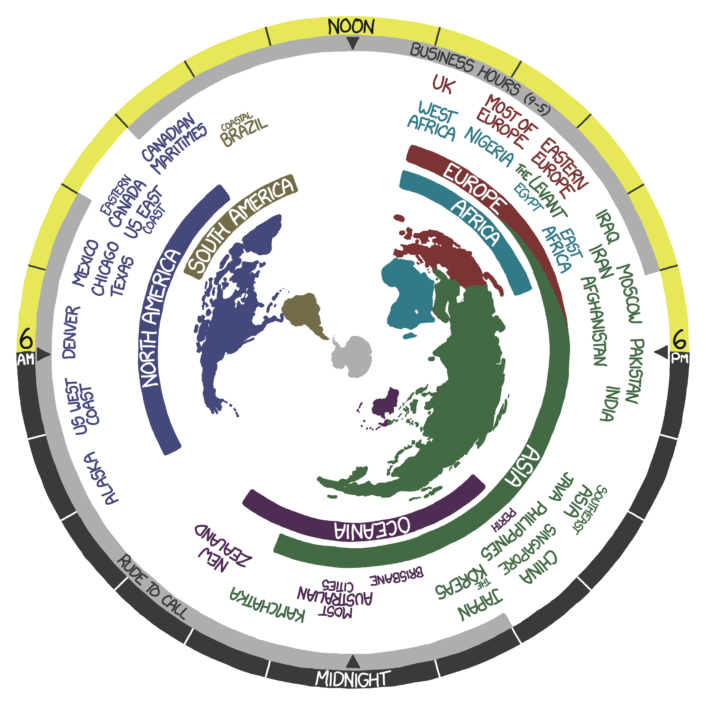
What time is it?

A handy visual map of world time,
drawn by the awesome Randall Munroe at xkcd.com .
If it's rude to call their area at a given time,
it's also unlikely you'll see those people at an online event.
Keep this in mind when scheduling RP or hunting!

Thursday, March 27, 2014

How to: Prepare and review logs for an incident report

This article is part 3 of a series on logs. Part 1 of the creation, and Part 2 on the cleaning of personal logs, are in the archives.


We in the Vigiles are very low-drama. We strongly believe drama and rumors are a thing for rp stories and intrigues, and we expect honest, honorable, and forthright behavior from our members in all ooc interactions, in and out of guild space.

That said: even the best of us have misunderstandings among ourselves, and from time to time we will all encounter people who do not live up to the virtues we expect from ourselves. It is our position that these conflicts are best resolved in a public or officer-mediated space, with transparent, documented processes and stable, clear guidelines.

Violations of the EULA are of course, best left to SOE.

For all other personal conflicts, within the guild or not, our single greatest resource for promoting justice is the keeping and reviewing of logs. 

In the heat of any rp scene or hunt, there are inevitable mistells, overlooked chatter, and unclear or misinterpreted dialogue. Running your logs through the cleaner program, in the same way you would for personal archiving often allows you to clear up simple misunderstandings and/or gain a little distance from an emotional scene.

That record can also crystallize problematic interactions and grant us the necessary perspective for discerning when a behavior is part of a larger pattern, and when an action clearly oversteps the allowance for misunderstandings and transgresses our rules.

Even if you have not yet reviewed your logs, if you feel an IC or OOC transgression has occurred, or if you the player are feeling unsafe, objectified, disrespected or in any other wise uncomfortable: Please! Do not keep silence for the sake of an imagined peace. Go to an officer as soon as you are able. We are here to guide and protect all the Amicae, both in battle and in life. Poison festers in silence and shadow: we cannot take action unless we know there is cause to act on.

As of this writing, the officers and their alts are listed below. 
Feel free to approach any of them in private, through /tell, /group, in-game mail if you are able, or to the guild email which is only accessible to the officers of the high council.

  • Praetor Ariahdnia 
    • Alts
      • Zapdash
      • Chrysopraze
      • Chevanima
      • Veset
      • Karrha
  • Legate Sytan
    • Alts
      • Folodu
      • Baarca
      • Skih
      • Marconis
      • Luddicia
  • Legate Fafnier
    • Alts
      • Andrejja
      • Urgnog
      • Edusa
      • Yorrik

Please note: If the dispute is solely an IC matter, please specify that you are wishing to have the matter handled only IC. If the issue is an IC interaction that crosses your boundaries, violates our OOC rules, or in any way is an issue outside of the story-space of role-play, please make that clear to your officer(s).


In the course of bringing an incident to the officers' attention, or as the officers investigate an open incident, you may be asked to provide logs. Further details about what logs are may be found in part 1 of this series.

  • If you do not have logs, they will be requested from the other actors in the event which has been brought to our attention.
  • If no logs exist of the incident in question, the matter will remain open, and all actors will be asked to keep logs going forward.
  • Any repeat of the offense while a matter is in open consideration will escalate the officers' analysis of the severity of the matter 
  • Any member who fails to keep and provide logs after a specific request from an officer will be reprimanded.
  • Any member involved in an investigation who fails to provide clear, undoctored logs for the timeframe requested will be subject to reprimand, and judgment based on whatever logs are available for review.
  • Screenshots of chat are an acceptable supplement to log files, but due to tabbed chat filtering, are not a substitute for logs in most cases.
  • If you have been approached by an officer for logs, you may ask about the nature of the investigation: however, bear in mind that details of matters in open consideration may be kept confidential until a judgment can be rendered. Refusal to cooperate with the officers, obstruction of process, or harassment of ANY players will be considered an admission of guilt to any and all potential offences and may result in severe reprimand or exile.
  • The officers of the Vigiles Amicae do not have jurisdiction to reprimand non-members. Documented incidents with a member of another guild may be brought to the officers' attention, and we may conference with the officers of the other player's guild if the situation warrants it, but no particular outcome can be expected from those proceedings.
  • If the actions of a player have been deemed severe enough by consensus of the High Council, all known alts of the player in question may be placed on access:none for all guild rp spaces, and an incident report will be prepared and filed for public record. Note: this is our standard process when encountering garden-variety trolls.
  • Hearsay is not admissible as evidence in conflict resolution. The report will be noted and shared with other officers, but any such rumor shall remain an unofficial notation until and unless substantiated by logs or evidence of the rumored behavior being repeated.
  • Not all requests for logs or screenshots are matters of transgression: on occasion, you may be asked to submit logs for combat analysis (for example, after a spectacular raid fight), rp event archiving, or even to harvest npc or other lore flavor-text.


If you've been keeping and organizing logs for a while, you know how big chatlogs can be. When an officer requests logs, they are NOT asking for the entirety of your chatlog archive.

So what are they looking for?

The officer you are talking with will explain in greater detail, but as a general rule, you will be asked to provide a log for roughly the 24-hour period surrounding the incident in question, from logging in to logging out. You may be asked to provide logs from more than one character, and multiple log-in periods, depending on the situation and the stability of your internet connection during the event.

This process does take time, and you will be granted a reasonable period in which to assemble your logs, and during which the incident will remain open.

The first task is to identify when the incident began.
If you are bringing the issue to the officers, you are the best judge of this. You know what was said, and what was done, but how do you isolate that from the mass of your chat? Perhaps at the time it was happening, you had a suspicion that this was going to need further attention, and you took screenshots of the chat. In a perfect world, you might have a screenshot of the problem in action, but even if you don't, you might be able to use the Find feature in any basic word processor to land in the right vicinity of your raw, uncleaned log.

For the purpose of this tutorial, let us say that the problematic lines are as follows*: 

(1385327972)[Sun Nov 24 15:19:32 2013] \aPC -1 Trollbob:Trollbob\/a tells AnOOCChannel (3), "LOL I will steal all ur loots while ur ded"(1385328273) 
[Sun Nov 24 15:19:34 2013] Trollbob looted 71 Copper from the corpse of a party crashing gnoll.(1385328274) 
[Sun Nov 24 15:19:35 2013] You cannot loot while you are dead!

You might remember the phrase "steal ur loots" and search for that, to find these lines in the raw log. Reviewing the log reveals that not only was this a transgression of need-before-greed but a disrespectful comment by Trollbob. Perhaps after this, you broke group, and the incident ended there, or perhaps Trollbob continued giving you trouble afterwards. Now you have enough information to create a preliminary "clean log".

Wait! You said I was supposed to submit raw logs!

This is true: and also, in order to identify the timeframe you need to submit, it may be more efficient for you to create a clean log next, rather than wading through thousands of lines of combat text. From the lines above, we can see that part of the incident occurred at 15:19 on November 24, and the chatter was in both the AnOOCChannel and may have had components in /group chat. In the log cleaner, you would click only the boxes for "channels", "guild", and for "group", and narrow the timeframe to 3:19 November 24 to 3:19 November 25, and name the export file something like, "Trollbob_chatter_Cleancopy.txt".

That clean file might not be very big, and when you look at it, you might decide it doesn't cover enough time. Keep refining the variables in logcleaner until you feel the entire incident is represented in the clean copy of the log. Make special note of the timestamps at the beginning and the end of the clean copy of your log.

Next, open your raw log, and find the timestamp which matches the beginning of your clean log. Remember the Find feature will make this easier! You might insert a line break or two above this timestamp, possibly with a symbol like # or * for your own reference.

Now, do the same thing for the ending timestamp from the clean log. If there is a camping sequence near this timestamp, make sure to include it, and place your linebreaks and reference symbol after it.

Now, copy the entire section between your reference marks to a new text document. Name this something like, "Joe_Trollbob_chatter_rawcut.txt." The size of this text document should be SUBSTANTIALLY bigger than your clean copy.

Now what do I do with it?

You are now ready to submit logs to your officers. You might wish to write a short letter explaining the nature of the incident you are bringing to their attention, and mention that the heart of the incident occurs around the timestamps you've identified. You may choose to submit your clean log in addition to the raw log for the officer's convenience, but the essential thing is the raw, snipped version.

DO NOT give in to the temptation to edit the raw log any further. Do not remove code, timestamps, combat or loot data, channel chat, or tells. If you are concerned about revealing private conversation in /tell which was going on during the incident but which you believe is unrelated, you may discuss this with your officer. You may be asked to identify the other player(s) involved in those /tell messages so that they may be consulted. Be assured, that all material unrelated to the incident will be kept absolutely confidential between you, the players in question, and the officers analyzing the incident. 
In some cases, you may be given permission to censor those unrelated tells by replacing the text of the tell with a specific phrase: do NOT do this without officer permission. Sometimes conversation which might seem unrelated will have bearing on the case.

Why not delete the whole line?

Tampering with logs in an attempt to sway the council's judgment is a very serious offense. Lies, obfuscation, and other gaslighting are destructive to personal relationships and to group dynamics. In order to assure your officers that the logs you have submitted are genuine and truthful, they need to see the code and the timestamps at the beginning of each line. Remember that your logs are going to be analyzed as part of a body of evidence, and any inconsistencies will draw the officers' attention.

What if the other person tampers with their log to make me look bad?

We've seen it all in the years we've served as officers, and we ask you to trust us that we'll know. Conflict resolution can be a stressful situation, even and perhaps especially when you know that you behaved honorably. It is very important that we have the evidence we need to expose wrongdoing and predation, and your cooperation is essential in maintaining our safe space here in the Vigiles.

I don't want to cause drama, but even though this person was reprimanded and/or exiled I'm worried...

We understand that anxiety. Your officers have your back, and public Council judgments are final, without appeal. Any retaliation in the wake of an incident will be treated as a serious offense. Incidents among us are few and far between: those who cannot abide our rules do not keep their welcome long.
We recommend that any players who have been officially exiled be placed on /ignore by all members, and from time to time our ooc channel will change names to ensure that our ooc space remains exclusive to those who abide by our Writ and Rule.

What if they make an alt?

If you are contacted by a stranger, and you feel anxious about this, one of the best ways to discover whether the stranger is cause for concern is this: bring an officer into group with you, and with them present, invite the stranger. Reply to the stranger that you will not respond to further tells, but only to group chat.
If they will not join the group, you may safely assume they are trouble, and place them on /ignore.
If they join the group and then complain to you in a tell that they will not speak in a public space, tell your officer, then take a screenshot, place the player on /ignore, and kick them from the group. Be prepared to file this screenshot and corresponding logs with your officer for posterity.

I think this one person might be an alt of this other person, and they did this one thing in this other guild and I'm worried it will happen here, and this other person was there when it happened too.

We understand your concern, and we will take every reasonable measure to promote a healthy, fun environment here among the Vigiles. More information is always a benefit to the officers, and even without logs to substantiate that history, the more details we have the better we will be able to watch for patterns. You do not need to roleplay or group with anyone that makes you uncomfortable, and if the person in question earns your trust, more the better. If, however, they live down to your expectation, be assured the officers will take action as soon as there is evidence to work with.

I'm not in your guild, but this person was recently kicked from/left our guild and you shouldn't let them join because...

We are always happy to talk with the leadership of other guilds, and we firmly believe that a strong community is one with open, respectful, and honest dialogue, no matter what the IC storylines may do. Forewarned is forearmed, of course, and as with internal incidents, the council will make decisions based on hard evidence as detailed above.

Okay - but where do I send the log files and stuff?

We like to keep things simple, so it's a free account with the guild name. Vigiles Amicae at gmail dot com, without the spaces, of course, rather like our little blog here. Sending spam to the guild account will earn you a reprimand, so don't do it.


* This is an example created for the purpose of this tutorial. Loot-stealing while a party member is dead is no longer an issue in game, so it works especially well as a neutral example.

Thursday, March 6, 2014

A Question of Time

In the Vigiles, we rely on the concept of Soft Time in our role play. This means the passage of time is flexible, and determined by narrative and the agreement of the players involved, rather than any particular fixed formula.

In dialogue, this means we usually refer to time with quantities like "some", "many", and "lots"*. We tend not to talk about firm dates more than a week or two in the future when we're in character,

But, When did things happen in Norrath?

There is great disagreement about the timing of historical events in the Norrath of Everquest 2. By design, the world of Norrath is slightly broken, and there are places where no time passes at all, time runs backwards, time runs faster... you get the idea. No powers in EQ2's Norrath have ever had much success agreeing on the time of day, let alone what year it is!

But-! There's a date when I type /time!

Yes, and in the original release of the Shattered Lands, it was standard practice for roleplayers to use /time as a reference. It was simple, it was built-in, and nobody had to do very much math to figure out what time it was in Norrath when it was Happy Hour here on earth.

You say that like it's not true anymore.

Just now, I ran the /time command and was given the year 3923 - which is only 212 years after the "official" date of the Shattering of Luclin. This corresponds to no method of Norrathian time equivalencies that I know of - but what is worse, I have logs from 7 years ago that have a /time artifact of 3950 and later.
So.
Although /time is still a built-in command in the game of EQ2, the answer it gives you is no longer reliable - or even the same from player to player. It's still a neat feature to add some flavor to your rp, to run a quick /time check and site your character in the month and season it gives you. After all, no matter what time format other players are using, you can't be more than nine days off on the day of the week, 2 on the season, or 11 on the month. Being "wrong" about the day according to someone else's way of measuring time also gives you an instant story hook - where did you - or they! - lose that time?

So... what year is it? The game came out on a certain day, so can't we just count from there, even if the game counter is bugged? Should I bug report it?

We don't know, not for certain, and don't bother with reporting it as a bug. Even the original development teams couldn't agree on how time should work in EQ2, and rather than resolve the dispute, they built the game around all of the approaches at the same time. You can count from launch day, if you like, but there's more than one way to do it, so don't expect other role players to be using the same measuring stick.

When in doubt, use soft time.

Well, I'd like to know what time it MIGHT be. If we started from launch day, and counted each day/night cycle as one day...

It can be done. The math is interesting, because one full day/night cycle now runs 72 minutes long**, but with a decent knowledge of spreadsheets, you can calculate the exact game-clock date of any time stamp you care to try***. This odd length of time allows even daily players with a set earth-time for playing to experience every time and season of Norrath in their playtime. There are a few world events which still rely on the Norrathian time to determine spawn rates, though in the years the game has been running most have been removed or set to a base timer of 15 earth minutes or less.

A Norrathian week is 10 days long, a month is exactly 3 weeks, and each of the three seasons is 4 months long, for a 12 month year. Like our own Ancient Greeks, Norrathians group their years in Quatrains, but in Norrath each year has an elemental association and unique weather influence. For example: if you're in Freeport during the year of the Triumvirate, you'll notice it's always raining, whatever the season is supposed to be.

That's nice, but what day did the game start, so I can start number-crunching?

I've looked, but I can't determine what time of year the game clock was started. But, since there's some wobbliness about time in general after the Shattering, even the year is a but of guesswork.
For every date in the game-clock method of time progression, you'll have to give or take about 500 years, since no official, extended universe, nor fan-created timeline agrees with itself or with any other. However: most NPCs which are/were involved in the main storyline which launched with the game on day 1 informed your character that the Shattering was 500 years ago****. Official lore suggests the explosion of Luclin happened around 3711.
Therefore: launch day might be reasonably assigned as coinciding with:
Moorday, 8 Blossoming of the Growth Season in the Year of the Triumvirate, in the Age of Shattered Lands 4211.

But that means more than 60,000 years have passed! Everyone who was alive at launch should be long dead -!

It's an easy mistake to make, if even one number in your progression is incorrect, or in the wrong order. This kind of math sortof... bends your brain, if you're like me, but once you have the formula correct, it's very satisfying.

Years the game has been running...9.33
...multiplied by days...3,405.83
...multiplied by hours...81,739.99
...multiplied by minutes...4,904,399.20
...divided by 72 minutes per Norrathian day...68,116.66
...and 12 Norrathian months...5,676.39
... and 30 days in a Norrathian month.189.21

By this calculation, about 189 years and most of three months have passed in Norrath, as of today. That means the year is roughly 4400, and although most humans and other short-lived races alive at launch might be dead, the Shattering would still be in living memory for most elves. If the game clock started at day 0 of the year 4211, then we can calculate today's date as follows:

Norrathian year at launch4211
Norrathian month1Deepice
Norrathian day1st of DeepiceFeastday
Norathian year now4,400.21
Norrathian month3Stargazing
Norrathian Day14th of StargazingSoulday

or, if you think the clock may have started in the Year of the Triumvirate, the result is still very close:

Norrathian year at launch4211.33
Norrathian month5Blossoming
Norrathian day8th of BlossomingMoorday
Norathian year now4,400.55
Norrathian month7Scorchedsky
Norrathian Day14th of ScorchedskySoulday

Either seems roughly plausible, with the following catch: in that scheme, our experience of Frostfell - and other holidays! - as players bears no relationship whatsoever to the ingame year or season.

Can it sync up at all as designed? 

Short answer: No.
Because the Earth year is not 360 days long (to the eternal torment of those who would prefer the poetic and mathematical ordering of days), no, it can't. Over the course of a single earth year, the Norrathian calendar would repeat the quatrain every 72 days: a little more than five times.

Can we "flex" the Norrathian calendar in a particular month to make it sync artificially?

Yes, if you want to do the math fresh every year, you can stretch four Quatrains over the course of one Earth year, and force at least ONE holiday to fall correctly in both calendars.
I don't recommend it, as it made my head hurt.

What about that other method you mentioned? Does that "fit"?

Short answer: Not quite as designed, no.
In the Concordium Tower in South Qeynos you will find a book titled, "The Norrathian Code of Trade Standards". We have a copy in our Library and in our Guild Hall. In that text, the ordering of the months, seasons, and quatrains is explained. Each year of the Quatrain corresponds very clearly to our four Earth seasons, and in the description of the Year of the Triumvirate it is revealed that the last month of the year - and therefore, the quatrain - is a time of feasting and celebration, when Norrathians give gifts to one another.

Ah ha! That's Frostfell!

It is, and the Frostfell event occurs every year for some number of Earth days to either side of December 25th*****.  So! If you discard the rigidity of 30 days to a month, OR, you create null-periods at the end of every quatrain to absorb the extra days, you can stretch the Norrathian quatrain over one Earth year.

What's the catch?

The coincidence of Frostfell in the Deadening of Triumvirate with Yuletide in December in Winter only works for the Northern Hemisphere. EQ2 is played all over the globe, so any scheme which shows favor to any group of players based on geography is a Bad Idea.
Furthermore, if only one quatrain passes each year, then only a little over 37 years have passed since launch. That's very little time for the epic events of Norrath to take place in, although it does mean that the Shattering could be in living human memory as well.

Well, 200 years isn't very long either.

No, it's not, especially since the climate has stabilized gradually after the Shattering. The siezmic and astronomical events which shaped the Norrath we know and love were truly, unimaginably catastrophic. Remember, in the original Shattered Lands, there were only a few pockets of survivors, worldwide, and magic was unpredictable and incredibly limited. It takes time for those kinds of things to stabilize again.
Recently the moon has even been fusing itself back together...

They could be gluing it back together with magic. Or the Gods could be doing it. Norrath doesn't have to use REAL physics.

All good points - but from the beginning, EQ2 was designed to bring Norrath to vivid life, and in order to do that, the designers worked to create a plausible and consistent world for us to move in. The intention was to incorporate real physics, real geology, real materials and textures in a beautiful, magical, exciting world which didn't ask us to suspend too much of our disbelief to imagine our way through it.

But Norrath has time travel, with Chronomagic.

Right. So we may not actually be in the year we think we are, by any count. 
Chronomagic was envisioned as a way to revisit old content without necessarily needing to make the monsters trivial or have a low level group member with you. The way Chronomagic was woven into the main storyline added further ripples to the strangeness of time since the rebuilding of the Spires back in 2006****** and was never resolved. 
It has been suggested that as a side-effect of stasis-magic used in the City wards, that time may pass significantly more slowly in the two largest cities, Freeport and Qeynos, than is does in the rest of the overland world. Consistent with fairy lore in our own world, it has been suggested that time also runs more slowly in most of Faydwer.
It has also been suggested that time does not pass in any measurable way in Neriak, Odus, Sky, Ykesha, or for obvious reasons, Ethernere.

So... what time references can we use to relate to guild story?

As part of our effort to integrate our own stories into the world of Norrath, we of the High Council have developed a perhaps idiosyncratic method, which you are welcome to adopt or not as you choose.
In the interest of brevity, we do not track the days of the week in Norrath. We may run a /time to harvest the "current day" for flavor, at the most.
Instead of referencing Earth seasons of winter or summer, we refer to the years of the Quatrain.

XegonyDecayJanuaryDeepice
DecayGrayeven
GrowthStargazing
GrowthWeeping
GrowthFebruaryBlossoming
GrowthOceansfull
HarvestScorchedsky
HarvestWarmstill
HarvestMarchBusheldown
HarvestLastleaf
DecayFirstchill
DecayDeadening
Fenin RoDecayAprilDeepice
DecayGrayeven
GrowthStargazing
GrowthWeeping
GrowthMayBlossoming
GrowthOceansfull
HarvestScorchedsky
HarvestWarmstill
HarvestJuneBusheldown
HarvestLastleaf
DecayFirstchill
DecayDeadening
RatheDecayJulyDeepice
DecayGrayeven
GrowthStargazing
GrowthWeeping
GrowthAugustBlossoming
GrowthOceansfull
HarvestScorchedsky
HarvestWarmstill
HarvestSeptemberBusheldown
HarvestLastleaf
DecayFirstchill
DecayDeadening
TriumvirateDecayOctoberDeepice
DecayGrayeven
GrowthStargazing
GrowthWeeping
GrowthNovemberBlossoming
GrowthOceansfull
HarvestScorchedsky
HarvestWarmstill
HarvestDecemberBusheldown
HarvestLastleaf
DecayFirstchill
DecayDeadening
We number each quatrain progressively in relation to the Age they belong to, which is pretty easy to do off the top of your head without even needing to look at the chart. The Age is whatever the last expansion was, the quatrain number tracks how many January 1 have passed since the expansion's release, and the Year name corresponds directly to every third month of the year.

A chart of the ages and their earth dates has been prepared in case you want to look up any given month, year, or age in our little corner of Norrath. These are the dates we use on any of our IC "official reports" and archives, if they have them.

This is all too much. Do I have to memorize all this wibbly-wobbly time stuff to role play with you or join the guild?

No, certainly not. Remember, we rely on "soft time" in most of our stories. All of this is just for your own interest, as a tool you may choose to incorporate, or not. 

And because we're geeks*******.


* tomorrow, next week, next month, next season, soon, someday, in the future, when x happens, yesterday, last week, some weeks ago, months ago, a while ago, long in the past, after x happened, before x happened, when x was happening, in ancient times...

** It used to be 40 minutes, and some are saying since the day/night transition started to have issues around the time ToV launched, that now the cycle is 90 minutes long.
I know. It's maddening.
Years the game has been running...9.33
...multiplied by days...3,405.45
...multiplied by hours...81,730.80
...multiplied by minutes...4,903,848.00
...divided by 40 minutes per Norrathian day...122,596.20
...and 12 Norrathian months...10,216.35
... and 30 days in a Norrathian month.340.55
and with 90 minutes:
Years the game has been running...9.33
...multiplied by days...3,405.45
...multiplied by hours...81,730.80
...multiplied by minutes...4,903,848.00
...divided by 90 minutes per Norrathian day...54,487.20
...and 12 Norrathian months...4,540.60
... and 30 days in a Norrathian month.151.35
We're going to use 72 minutes for this article as that was the length quoted recently by the EQNext development team in their poll of potential players. They wanted player feedback on the length the days should be, and one of the options was "72 minutes, like EQO and EQ2". So we're using that, for now.

*** Yes, Ari is developing a spreadsheet for guild use. Yes, it will be ported to the calendar. No, I don't know how to build a calculator widget, and neither does Ari. Yes, you can build one if you want, and if it works we'll put it on the blog.

**** Some roleplayers at that time, especially on the Qeynos side, started their personal story clocks by the Shattering itself, discarding the old calendar to place the end of the Shattering at Year 0, and their stories at or around Year 500. Since the Shattering was a pivotal event, causing massive climate disruption in a world which had already been undergoing the Rending of continents for the better part of a century, both catastrophies tended to blend together in the lore, and the clean slate posited by this method made - and still makes - a great deal of narrative sense. By this accounting, current Norrathian time is in the 1st or 2nd Century P.R. (Anno Post Ruinum)

***** In 2013, Frostfell began near the beginning of December and extended to January 9th - it varies every year.

****** The result for /time in Kingdom of Sky when it launched was Year 0, and still is.

******* Yes. Enormous ones.

Wednesday, March 5, 2014

Selections from: Notes on Diverse Magicka - Natural Arcana

Notes on Diverse Magicka

by

Legatus Pax Sytan Fiac


Author's note:

This is a series dedicated to informing those with limited or non-extant abilities in arcana on the various forms of magic and their uses. This is not intended as an in depth study, nor does it go into all details. For many, the usage of leylines or nodes will never manifest, nor will the finesse to guide the blood magicka explicitly.

This discourse will cover the concepts of similarities and differences among the branches, and peel back some of the mysteries.

The first section will cover my specialties of hematurgy and necromancy.
The second will cover natural magicka.
The third will touch on the psionic talents.
The fourth will delve into the divine controversy.
The fifth will touch upon the delicate and complex question of void.

It is to be hoped that the interested student will find the more technical treatises on the above topics more readily accessible for this humble offering. Any errors or elisions in this work must be attributed to the difficulty of enumerating in plain language what becomes a nearly reflexive, intuitive impulse for the grand adept.


Natural magicka contains many similar properties depending on what things answer to who, and what the power source is. As with all branches, the first inclination is to use self as the power source - blood is not called for in natural magicka, and instead the accumulation of 'mana' serves.

The current thought on how this occurs is by a form of osmosis, at latent background levels deep into all things all the time, with areas around nodes having a higher concentration. The practiced mage can draw from loose, pooled, or flowing mana to greater or lesser degrees according to both talent and training, although the modulation and direction of this power must be drawn directly from the mage's own vital energy.

It may be helpful to think of these mages above the rank of master as drawing this mana as one would draw water from a spring-fed well. The size of one's bucket, and efficiency of one's winch and pulley will have a marked impact on the upwards limit of how much water may be harnessed, but the final arbiter of what is possible will always be dictated by the strength and endurance of the operator. Foci and ritual may be likened to manual pump systems, with all the implied exponential increases in throughput that suggests, even though the maximum harnessable vitality of the operator remains the same.

To stretch the metaphor slightly further, one can only begin to picture the sheer power represented by the rare grand adept by considering that they are a living embodiment of several things at once.

Like the mechamagical mana batteries which power an automatic hydro pump, their base vital capacity is at once far greater than our proverbial winch-and-pump operator, and like those batteries, may be refilled to some degree by the very act of their proper use. Like the well operator, they can draw from still pools, and like the diversion pumps, they can also draw off moving streams of mana and redirect them with minimal filtration. The grand adept also operates like the great reservoirs and their pressure turbines - as well as the reservoir itself - able to at once open the proverbial sluice-gates of natural and created mana reservoirs for direct use, and to contain and channel some amount of that power into forms that so-called lesser Adepts and Master-grade mages can then tap.

Unlike all of these devices, the grand Adept as a living creature is highly mobile, as they can adapt themselves and their physical environments at will, and are further able to "tune" the varied sources of mana, manipulating the very composition and alignment of these mana networks. The reach of a Grand Adept is finite, but the upper limit has never been finally determined, nor is it likely to be: like every other endeavor, the practice of Arcana builds on all that has come before, and thus climbs to ever more precipitous heights.

The reader may well ask how, with such power, a Grand Adept can ever be defeated. Unfathomable though it may seem from a mundane perspective, Grand Adepts do have variations of ability within and between themselves. Consider that the oceans are several orders of magnitude more vast and powerful than any inland sea, lake, or even pond, and one may begin to grasp the nature of the distinctions in this field of magicka - and also where the limitations and weaknesses of these rarified beings might begin.

As the Oceans are both beautiful and terrible, so it is with Grand Adepts. They are but mortal creatures, and many potential Grand Adepts are themselves destroyed by the raw power that they work upon and within. Isolating one from the network of mana sources is an enormous task, but entirely possible, and in the same way that a Grand Adept may tune the local network for their ease, it may also be made discordant and poisonous to them. The reader might do well to consider the extravagant loss of life, and utter decimation of organized magicka following the Great Rending: it was not until the Era of Discovery that true Grand Adepts began to emerge again.

There are those who will always assert the increased contact with draco nobilius was the cause and support of this development: the reader may rest assured the reason is far less dramatic. Final Death and the imperfect vagaries of the Restorative Arts destroyed forever many of the greatest mage-gifted bloodlines during the Age of Turmoil. The survivors were hardly in a position to organize anything like a formal breeding program to strengthen and fix the remaining talents, even had they access to the relatively stable and vibrant mana network we use today.

Tuesday, March 4, 2014

OOC Resource: Heraldry

Thought I'd compile a short list of resources for the invention of heraldry and coats-of-arms. Many characters are from noble families, or have fought on behalf of a state or organization which would have its own heraldic device, so knowing the standards of heraldry and blazons may come in handy as a player.

The first links are obvious, to Wikipedia's articles on Heraldry and Blazon. Blazon is the (mostly) standardized method of describing a heraldic symbol so that someone else can reproduce it. The blazon is a very specific formula with its own syntax that specifies colors, divisions, emblems, and arrangements of the heraldic emblem. With blazon terminology, one can describe a shield or coat-of-arms more accurately and with fewer words than with regular English.

This page is from a gaming miniatures decoration website, and extremely good for visualizing what the blazon terminology means in graphical form. The Canadian Heraldic Authority is also a good resource, with a fun little pdf for kids on the subject that is actually quite good at describing how heraldry is inherited and modified in the inheritance.

If anyone else has any other info to share about heraldry, please add it in the comments.

Wednesday, February 5, 2014

Selections from: Notes on Diverse Magicka - Necromancy

Notes on Diverse Magicka

by

Legatus Pax Sytan Fiac


Author's note:

This is a series dedicated to informing those with limited or non-extant abilities in arcana on the various forms of magic and their uses. This is not intended as an in depth study, nor does it go into all details. For many, the usage of leylines or nodes will never manifest, nor will the finesse to guide the blood magicka explicitly.

This discourse will cover the concepts of similarities and differences among the branches, and peel back some of the mysteries.

The first section will cover my specialties of hematurgy and necromancy.
The second will cover natural magicka.
The third will touch on the psionic talents.
The fourth will delve into the divine controversy.
The fifth will touch upon the delicate and complex question of void.

It is to be hoped that the interested student will find the more technical treatises on the above topics more readily accessible for this humble offering. Any errors or elisions in this work must be attributed to the difficulty of enumerating in plain language what becomes a nearly reflexive, intuitive impulse for the grand adept.


In part one, we compared and contrasted hematurgy and necromancy. Part two focused on hematurgy. Part three, therefore, is on the necromantic arts.

Necromancy relies on subjugation and animation for its workings, which is precisely what conjuring an elemental requires. The difference lies in the power source. The necromancer relies on the power of pain and blood, as they are calling dead flesh to move again, and like calls to like - blood responds to blood.

As contrast, an elemental conjurer calls on their own power, or the power of lay lines and nodes. Nearly all other elements are shared.

Dead flesh has no motivator force to give it direction. Subjugation, or the forcing of will upon a thing, is the key first step. With no will to maintain movement, all energies fed to an undead thrall soon dissipate.

There is always some challenge at this, as the original inhabitant of the body can still influence how the flesh responds - or in most cases doesn't - especially if the inhabitant is a ghost. If the working is vital, going out of the proximity of the ghost can assist matters, as can banishing or appeasing it.

In certain rare cases, ghost and body can be brought back together and instill life once again, though this is so rare as to have no known causal factors.

What is known, however, is that ghosts do not hold well to flesh that was not their own very easily, and any stresses can break a binding.

Animation, or kineticism, is the other end of the necromantic working. Many mages are capable of such, and again the difference is power source.

Even with a will, undead flesh still does not wish to move. It will need direction at every point. Some necromancers will link this to their thought, and others will 'teach' certain movements and convey special instructions from there.

Which ever way direction is given, animation is thus bestowed, completing the familiar.

In parts one and two, ritual was mentioned. Because the natural order of magic and motion is broken in working with the dead, a full ritual is not just necessary, but required. The power needs explicit direction and shape that intention cannot bestow.

The symbols and representations guide the shaping even as much as a Druid or shaman's magic might. Without, the least you get is wasted time, and the worst is a thrall that tries to kill you. Rare cases exist where the unattached thrall is docile and accepts no commands, though one can guess the majority of these are unreported.